Introduction
Door hinges are the hardest-working hardware on any door—whether interior, exterior, or cabinet—keeping doors properly aligned, functional, and safe through thousands of open-close cycles. Under ANSI/BHMA A156.1 standards, residential hinges are tested to withstand 350,000 cycles, while commercial-grade hinges endure 2.5 million cycles.
Despite their durability, hinge problems are widespread. Daily wear, humidity, poor installation, and inadequate maintenance cause screws to loosen, pins to seize, and doors to sag or bind.
According to industry testing data, most hinge failures stem from preventable issues: wood fiber compression around screw threads, lack of lubrication, and improper screw lengths.
This guide walks through the most common hinge problems, step-by-step repair instructions, when to replace instead of repair, and how to stop issues from coming back.
TL;DR
- Most hinge problems fall into four categories: loose screws, squeaky pins, binding, and rust—all fixable with basic tools
- Stripped screw holes can be repaired using wooden dowels or longer screws without replacing the hinge
- Replace the hinge when metal is bent, cracked, or deeply corroded
- Preventive lubrication and annual screw checks extend hinge life by years
Common Door Hinge Problems (and What Causes Them)
Most hinge failures follow predictable patterns. Recognizing symptoms early saves time, prevents costly structural damage, and keeps doors operating safely.
Loose or Sagging Hinges
Symptoms:
- Door droops or hangs crooked
- Swings open on its own
- Visible gap between hinge leaf and door jamb
Likely causes:
- Screws have worked loose from repeated use and door weight
- Screw holes have widened from wood fiber compression
- Short screws (typically 1 inch) that anchor only into the jamb, not the wall stud
Standard 1-inch hinge screws often fail under heavy door loads because they grip only the 3/4-inch jamb. Replace the top hinge's center screw with a 3-inch screw that reaches the wall stud — a standard trade fix that holds under heavy door loads.
Squeaky or Stuck Hinge Pins
Symptoms:
- Audible squeak or groan when opening or closing
- Hinge pin is difficult or impossible to remove
- Stiff door movement
Likely causes:
- Metal-on-metal friction without lubrication
- Corrosion or paint buildup around the barrel
- Pins left untouched for years
Lubrication fixes most pin problems quickly. When the door still won't move smoothly after that, the issue is usually structural.
Hinge Binding and Door Misalignment
Symptoms:
- Door rubs against the frame or won't close flush
- Springs back open after closing
- Uneven gaps at top or side of door
Likely causes:
- Door jamb is out of plumb
- Hinges installed with incorrect mortise depth (too shallow or deep)
- House settling has shifted the frame over time
The standard clearance between door edge and frame is 1/8 inch, with a maximum of 3/16 inch for fire doors. If your gaps fall outside that range, the hinge mortise depth or jamb alignment is likely the culprit.
Rust and Corrosion
Symptoms:
- Reddish-brown discoloration on hinge surfaces
- Pitting on the metal
- Stiff or difficult door movement
Corrosion typically develops from extended moisture exposure, missing protective finish, or low-grade metal. Exterior and bathroom doors are especially vulnerable.
ANSI/BHMA A156.18 standards use salt spray testing to rate corrosion resistance: stainless steel hinges must withstand 200 hours, while standard plated steel may only require 24 hours. For any door exposed to humidity, stainless steel or solid brass hinges are worth the upgrade.
How to Repair a Door Hinge: Step-by-Step
Attempting to fix a hinge without confirming the root problem leads to repeat failures. A few minutes of diagnosis saves hours of rework.
Step 1: Diagnose Before You Touch the Hinge
Open and close the door slowly. Observe:
- Does it drag, squeak, or sag?
- Where does the hinge look loose, paint-covered, corroded, or misaligned?
Check all screws with a screwdriver:
- Screws that turn freely = stripped holes
- Screws that are simply loose = tighten with longer screws
This distinction determines the repair method.
Step 2: Fix Loose Screws or Repair Stripped Screw Holes
If screws are loose but wood is solid:
- Remove the door (wedge it open and support from below)
- Tighten each screw clockwise using a drill or manual screwdriver
- Replace standard screws with 3-inch screws to reach the stud behind the jamb for stronger anchoring
If screw holes are stripped (screws spin without gripping):
- Drill out the holes with a 3/8-inch bit
- Cut wooden dowels to match the hole depth
- Coat dowels with carpenter's glue and hammer flush
- Allow to cure fully—PVA carpenter's glue requires 24 hours of unstressed curing before re-hanging heavy doors
- Drill new pilot holes and reattach the hinge
This technique is especially relevant for wood-framed cabinet doors, where the surrounding material is softer and more prone to stripping over time.
Alternative for minor stripping:
Fill holes with toothpicks and wood glue, snap off flush when dry, and drive new screws—a faster method suitable for lighter interior doors.
Step 3: Lubricate or Replace a Squeaky or Stuck Hinge Pin
For squeaky pins:
- Remove the hinge pin by tapping it upward from the base using a nail punch and hammer (never a screwdriver, which damages softer alloy pins)
- Clean the pin with a brush and solvent
- Coat lightly with white lithium grease, silicone spray, or dry PTFE lubricant
- Reinsert and test
For stuck or rusted pins:
- Apply penetrating oil (PB Blaster or WD-40 Multi-Use) directly to the barrel
- Wait at least 15 minutes before attempting removal (overnight for severely seized pins)
- Once removed, assess whether the pin is salvageable or needs replacement
Lubricant Comparison:
| Lubricant Type | Best Use | Duration |
|---|---|---|
| White Lithium Grease | Heavy exterior doors (-20°F to 400°F) | 6-12 months |
| Silicone Spray | Interior doors, bathrooms, coastal areas | 3-6 months |
| Dry PTFE Lube | Clean environments requiring no residue | 4-8 months |
| WD-40 Multi-Use | Penetrant and cleaner only (not long-term lube) | 2-4 weeks |
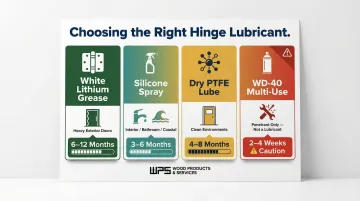
Important: WD-40 Multi-Use is a water displacer and penetrant, not a long-term lubricant. It can strip existing oils and dry out quickly. Use dedicated lubricants for lasting results.
Step 4: Shim and Realign a Binding or Misaligned Door
Measure the gap difference between the top and bottom of the door on the latch side. If the gap varies, shimming is needed.
For gaps under 3/16 inch:
- Remove each hinge (start from the top, save the middle for last while the door is wedged)
- Insert cardboard or plastic hinge shims behind the hinge leaf to push the door back into plane
- Reinstall and test the door's swing and clearances after each adjustment
- Continue until the door closes flush without binding
Step 5: Clean and Treat Rusty Hinges
Surface rust is common on older hinges and responds well to mechanical cleaning paired with a rust treatment. Work through these steps in order:
- Remove the hinge
- Scrub with steel wool or wire brush to clear surface rust
- Apply commercial rust remover (or vinegar/lemon juice solution) for 5–10 minutes
- Scrub again until metal is clean
- Rinse, dry completely, and apply a thin layer of lubricating oil before reinstallation
If corrosion is deep and has pitted the metal or weakened the hinge structure, cleaning alone won't restore full strength. Replacement is the appropriate next step.
Fix vs. Replace: How to Decide
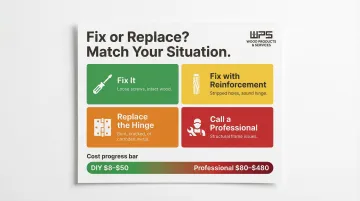
Use the scenarios below to match your situation to the right course of action — whether that's a quick fix, a reinforced repair, a full replacement, or a call to a pro.
Scenario 1 — Fix it:
- Screws are loose but wood is intact
- Hinge is structurally sound
- No visible corrosion or bending
- Retighten or swap in longer screws to restore grip
Scenario 2 — Fix it with reinforcement:
- Screw holes are stripped but hinge metal is fine
- Use the wooden dowel or toothpick-and-glue method to rebuild the anchor point, then rehang the original hinge
Scenario 3 — Replace the hinge:
- Hinge leaf is bent
- Barrel is cracked
- Corrosion has deeply pitted the metal
- Hinge pin is corroded beyond removal
- Continued use creates safety and alignment risks — replacement costs less long-term than repeated repairs
Scenario 4 — Call a professional:
- Door jamb is out of plumb by more than 3/16 inches
- Frame has rotted or shifted structurally
- Repeated hinge repairs keep failing despite correct technique
- These symptoms point to a structural problem that hinge hardware alone can't solve
Cost Benchmarks:
- Standard replacement hinge: $8 to $50
- Professional door hardware repair or replacement: $80 to $480 (2026 data)
Common Mistakes to Avoid When Repairing Door Hinges
A few missteps can undo a solid repair or create new damage. Watch out for these common ones:
- Fix the cause, not just the symptom. Tightening screws without addressing stripped wood means the same problem returns within weeks. Identify the root cause before starting.
- Support the door before removing hardware. Without a wedge or prop underneath, the door's weight shifts and binds, bending remaining hinges or damaging the jamb.
- Choose the right lubricant. WD-40 works as a short-term penetrant but attracts dust and dries out. Cooking oils, motor oil, and petroleum jelly oxidize over time, turning into an abrasive paste. Use silicone-based products, dry lubricants, or beeswax for lasting results.
How to Prevent Door Hinge Problems
Perform annual hinge checks: Once a year, test every door in the home. Tighten any screws that have started to loosen and apply a thin coat of dry lubricant to hinge pins before they start to squeak. Catching issues early prevents screw holes from stripping.
Use the correct hardware from the start: Short screws and low-grade hinges are the most common reason repairs fail. Always use:
- Screws long enough to reach framing behind the jamb (3-inch minimum for top hinge)
- Hinges rated for the door's weight (BHMA Grade 1 for commercial, Grade 3 for residential)
For cabinet doors specifically, hinge longevity starts with how the cabinet itself is built. Professionally constructed frames — like those Quality Made Cabinets installs — hold hinge screws securely over time because the wood behind each mounting point is solid, properly dimensioned, and correctly aligned from the start.
Control moisture exposure: Hardware selection matters less if the environment is working against you. For exterior and bathroom doors:
- Apply a protective finish to exposed hinge surfaces
- Reapply lubricant after cleaning
- Consider stainless steel or coated hinges that resist corrosion in humid environments
Frequently Asked Questions
How much does it cost to fix a door hinge?
DIY repairs cost very little—typically just screws, wood glue, or lubricant (often under $10-$15 total). Professional hinge repair or full replacement, including labor, ranges from $80 to $480 depending on complexity and hardware type.
Can door hinges be repaired?
Yes, most door hinge problems—including loose screws, stripped holes, squeaking, and surface rust—can be repaired without replacing the hinge, as long as the hinge metal isn't bent, cracked, or deeply corroded.
Can a soft-close hinge be repaired?
Soft-close hinges can often be repaired by adjusting the built-in tension or damper mechanism using the adjustment screws on the hinge body. If the damper is broken internally, the hinge typically needs replacement rather than repair.
Do hinge repair plates work?
Hinge repair plates work well for doors where the hinge area of the jamb or door has split or weakened. They add surface area to distribute the load, but are not a substitute for fixing the underlying stripped screw holes.
How do you fix a door hinge with stripped screw holes?
Drill out the stripped hole with a 3/8-inch bit, glue in a cut dowel, let it cure for 24 hours, then drill a new pilot hole and reinsert the screw. Toothpicks and wood glue work for lighter doors as a faster alternative.
When should you replace a door hinge instead of repairing it?
Replace the hinge when the metal is bent, cracked, or deeply corroded; when repairs have failed multiple times; or when upgrading a door and mismatched hardware affects both function and appearance.