Introduction
Kitchen cabinets endure punishment that most surfaces never face. Greasy hands, splattered sauces, steam from boiling pots, and repeated scrubbing with cleaning solutions — cabinet surfaces take it all. Unlike walls, which get the occasional scuff, cabinets face daily moisture, heat, and contact. According to finishing industry data, improperly painted cabinets can begin chipping or peeling within 6–12 months under normal kitchen conditions. Paint choice here directly affects how long your cabinets last and how easy they are to clean.
The wrong paint leaves you with sticky surfaces that never fully cure and edges that chip the first time a cabinet door swings into the wall. The right paint creates a hard, washable finish that holds up for years — not just months.
This guide covers everything you need to make the right call:
- How cabinet paint cures differently than standard wall paint
- Top brand comparisons with real pricing and performance data
- Sheen selection strategies for different kitchen conditions
- How to match your paint choice to your budget and use case
TL;DR
- Water-based alkyd/urethane hybrid paints deliver oil-like durability with easy cleanup and fast dry times
- Sherwin-Williams Emerald Urethane Trim Enamel leads for self-leveling finish and scratch resistance
- Benjamin Moore Advance delivers factory-smooth results but requires 16-hour recoat windows
- Satin and semi-gloss sheens balance cleanability with low-maintenance upkeep
- Skipping primer is the fastest route to peeling and early finish failure; it's not optional
What Makes Kitchen Cabinet Paint Different from Regular Wall Paint
Standard wall paint dries through water evaporation and particle coalescence, leaving a flexible film. This works fine for vertical surfaces that get minimal contact. But cabinets need paint that cures—not just dries—forming a rigid molecular structure through oxidative crosslinking.
Key Technical Properties for Cabinet Paint
Enamel formulations matter most:
- Alkyd/urethane formulas cure to a hard, chip-resistant surface over 7–30 days
- Self-leveling agents reduce surface tension, minimizing brush marks and orange peel texture
- Resists moisture, grease, and steam — the everyday hazards in any kitchen
- Bonds to previously finished wood without peeling or lifting over time
Two Main Paint Categories
Water-based alkyd/urethane hybrids (recommended for most projects):
- Combine oil-based durability with water cleanup
- Cure through the same hardening process as oil-based paints
- Dry faster than traditional oil paints
- Low VOC formulations for indoor use
Traditional oil-based paints (less common today):
- Longest cure times (weeks to full hardness)
- Strong odor and high VOCs
- Require solvent cleanup
- Still preferred by some professionals for specific applications
For most kitchen cabinet projects, water-based hybrids give you the hardness you need with far less hassle — which is why they're now the default choice for professional cabinet painters.
Best Paints for Kitchen Cabinets: Top Brands Reviewed
These selections prioritize durability, application ease, finish quality, and real-world kitchen performance.
Sherwin-Williams Emerald Urethane Trim Enamel
A water-based urethane-modified alkyd enamel engineered specifically for high-contact surfaces like cabinets, doors, and trim. This is the most consistently recommended choice across professional painters and serious DIYers.
Standout features:
- Self-leveling formula minimizes brush strokes even with roller application
- Fast 4-hour recoat time at 77°F/50% humidity
- Excellent scratch resistance after full cure
- Low-VOC formulation suitable for occupied homes
- $126.49 per gallon (list price)
Limitation: Over-brushing after the paint starts to tack will leave marks—you must let it self-level.
| Attribute | Details |
|---|---|
| Paint Formula | Water-based alkyd-urethane hybrid |
| Available Sheens | Satin, Semi-Gloss, Gloss |
| Best For | DIYers and pros seeking the most durable, smooth finish with fast turnaround |
Benjamin Moore Advance Waterborne Alkyd
A waterborne alkyd paint delivering oil-like performance with water cleanup. Known for producing one of the smoothest, most factory-like finishes available in a DIY-friendly formula.
Standout features:
- Produces a notably smooth, glass-like surface with minimal visible brush marks
- Extended open time for better flow
- Available in four sheens including matte
- $88.99 per gallon (verify current pricing at retailer)
Trade-off: 16-hour recoat time between coats extends project timelines considerably. Full cure takes up to 30 days.
| Attribute | Details |
|---|---|
| Paint Formula | Waterborne alkyd (oil-like properties, water cleanup) |
| Available Sheens | Matte, Satin, Semi-Gloss, High-Gloss |
| Best For | Those prioritizing the finest possible finish and willing to wait longer between coats |
General Finishes Milk Paint
Despite the name, this is an acrylic mineral paint—not traditional casein-based milk paint. It bonds well to most cabinet surfaces with minimal prep, making it popular among beginners.
Standout features:
- Minimal surface preparation required
- Cure time (7-10 days for light use)
- Low fumes and easy application
- Self-sealing formula
Limitations: Only 12 color options available, single sheen level (satin/eggshell). Manufacturer recommends topcoat for maximum durability in kitchen applications.
| Attribute | Details |
|---|---|
| Paint Formula | Acrylic mineral paint |
| Available Sheens | One sheen (satin/eggshell); topcoat available for added gloss and protection |
| Best For | Beginners or those wanting minimal prep; best paired with a protective topcoat on cabinets |
Dutch Boy Cabinet, Door and Trim Alkyd Enamel
A budget-friendly water-based alkyd enamel that performs well above its price point—a reliable option for cost-conscious projects.
Standout features:
- Roughly half the cost of Sherwin-Williams Emerald
- $49.98-$56.98 per gallon at Menards
- Formulated for "glass-like finish" with no brush marks
- Anti-block formula prevents door sticking
- Works well with brush, roller, or airless sprayer
Limitation: Less independent third-party review data compared to Sherwin-Williams or Benjamin Moore; color selection is narrower than premium brands.
| Attribute | Details |
|---|---|
| Paint Formula | Water-based alkyd enamel |
| Available Sheens | Satin (slightly shinier than other brands' satins) |
| Best For | Budget-conscious projects where premium price isn't an option |
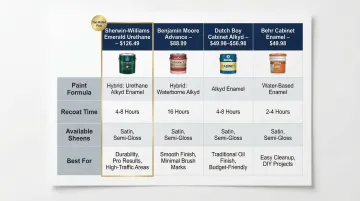
Behr Cabinet Enamel
The most widely accessible budget option, available at Home Depot. A cabinet-specific enamel and a common starting point for first-time cabinet painters.
Limitations:
- Stickiness issues reported by users in high-humidity kitchens
- Lower chip resistance compared to hybrid alkyd options
- Thorough sanding and a strong bonding primer are essential for lasting results
Pricing: $49.98 per gallon
| Attribute | Details |
|---|---|
| Paint Formula | Urethane alkyd enamel (water-based) |
| Available Sheens | Satin, Semi-Gloss |
| Best For | Entry-level budget projects with thorough prep; widely available at Home Depot |
Choosing the Right Sheen for Kitchen Cabinets
Sheen level affects both how your cabinets look and how well they hold up over time. Higher sheen means easier cleaning and better moisture resistance — but it also means more reflection and more visible surface imperfections.
The Four Common Sheen Levels
Matte/Flat: Almost no reflection and great at hiding surface flaws, but nearly impossible to wipe clean. Skip this one for kitchens.
Satin: Low to medium reflection. The most practical all-around choice for kitchen cabinets—hides fingerprints, durable enough for daily use, not overly shiny.
Semi-gloss: Medium reflection. More durable and washable than satin, ideal for a modern, polished look or darker cabinet colors. Shows imperfections more readily.
High-gloss: The hardest, most durable finish — and the easiest to clean. The trade-off is that it reveals every surface flaw and fingerprint, so prep work matters.
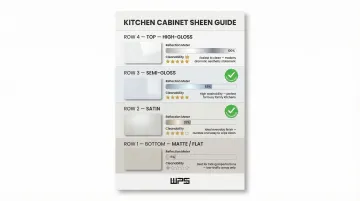
Knowing what each sheen does is half the battle. The other half is matching the right one to your specific cabinets and kitchen.
Practical Recommendations
Choose satin if:
- You want a balance of durability and subtlety
- Your cabinets have minor surface imperfections
- You prefer a softer, less reflective appearance
Choose semi-gloss if:
- You want maximum cleanability and moisture resistance
- You're painting darker colors (shows better depth)
- Your cabinets are in excellent condition
Pro tip: Sample two sheen levels in your chosen color before committing. Observe how each looks under both natural daylight and artificial kitchen lighting—the difference can be dramatic.
How We Chose the Best Cabinet Paints
Evaluation Framework
Paint recommendations are based on:
- Alkyd/urethane hybrid formulas, which outperform standard acrylics for hardness and durability
- Application performance — self-leveling behavior, brush/roller/spray compatibility, and ease of achieving smooth results
- Recoat and cure times, balancing project speed with final hardness development
- Scratch and moisture resistance in real-world, lived-in kitchen environments
Common Mistakes That Ruin Cabinet Paint Jobs
- Choosing paint by price alone — Budget paints still underperform premium options even with perfect prep. That $80 savings disappears fast when you're repainting two years later.
- Skipping primer — The most common reason cabinet paint fails. Primer ensures topcoat adhesion and prevents delamination.
- Confusing "dries" with "cures" — Surface dry (1–4 hours) means you can recoat. Full cure (7–30 days) means the paint has reached maximum hardness. Heavy use before full cure damages the finish.
- Reinstalling hardware too soon — Most alkyd paints need 2–3 weeks to fully harden. Closing doors or screwing in hardware before that point can leave permanent marks.
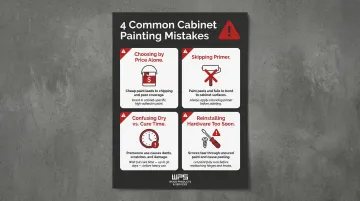
Why Priming Is Non-Negotiable
Proper surface preparation and priming make the biggest difference in longevity. The right primer depends on what you're working with — raw wood, a previously painted surface, or a factory finish each calls for a different approach.
Shellac-based primers like Zinsser BIN are the go-to for:
- Raw wood surfaces
- Previously stained or oil-painted cabinets
- Surfaces with tannin bleed or visible knots
Quality bonding primers work better for:
- Previously painted cabinets in good condition
- Factory-finished or glossy surfaces
- Hard-to-adhere substrates where heavy sanding isn't practical
Bonding primers like Sherwin-Williams Extreme Bond reduce sanding requirements while ensuring strong topcoat adhesion.
Conclusion
The most impactful decision in any cabinet painting project is paint choice. Water-based alkyd or urethane hybrid formulas deliver the hardness, scratch resistance, and moisture protection kitchen cabinets demand. Pair the right paint with proper surface prep, a quality primer, and adequate cure time, and you'll get results that last years.
Painting is an excellent way to refresh existing cabinets—but it has limits. If your cabinets are structurally worn, outdated in layout, or beyond what paint can fix, custom replacement may be the smarter long-term investment.
Quality Made Cabinets has been building custom cabinetry for residential and commercial clients since 2010, with over 780 completed projects across kitchen and bathroom renovations. Each cabinet is tailored to your specifications — plywood construction, hardwood face frames, soft-close hardware — and backed by a 12-month workmanship guarantee and a free post-installation check.
For homeowners whose cabinets need more than a fresh coat of paint, reach out to Quality Made Cabinets at (484) 719-8209 or kitchentransformations@yahoo.com. They offer free in-home consultations and 3D design previews so you can see your new kitchen before work begins.
Frequently Asked Questions
What do professional painters use to paint kitchen cabinets?
Most professional painters use water-based alkyd or urethane hybrid enamels—typically Sherwin-Williams Emerald Urethane Trim Enamel or Benjamin Moore Advance. These are applied over a quality bonding or shellac-based primer for maximum adhesion and durability.
What kind of paint is best for kitchen cabinets?
Alkyd or urethane enamel paints (water-based hybrid formulas) are best for kitchen cabinets because they cure into a hard, chip-resistant surface that holds up to daily use. Standard latex or acrylic wall paints can't match their durability or moisture resistance in a kitchen environment.
What paint finish is best for kitchen cabinets?
Satin or semi-gloss finishes are the best options for kitchen cabinets. Both offer easy cleaning and durability, with satin being more forgiving of fingerprints and surface imperfections, while semi-gloss provides a slightly harder, more reflective surface with superior washability.
What is the most durable finish for painted kitchen cabinets?
Semi-gloss and high-gloss urethane or alkyd enamel finishes are the most durable. The higher the sheen in quality enamel paints, the harder and more washable the surface becomes. However, high-gloss will show every imperfection and fingerprint more readily than lower sheens.
What does Sherwin-Williams recommend for painting cabinets?
Sherwin-Williams officially recommends Emerald Urethane Trim Enamel for cabinets, doors, and trim. They advise thorough surface preparation (cleaning and light sanding), use of a compatible primer on raw or stained wood, and allowing full cure time before putting cabinets back into heavy use.