
Introduction
Pick the wrong wood for a painted face frame and you'll see it in the finish—literally. Grain telegraphing through your topcoat, tannin bleed staining white paint yellow, or joints cracking after a single humid summer are all avoidable problems. They start with wood selection. Because the face frame is both highly visible and frequently touched, your species choice directly determines how long that painted finish holds up.
Not all woods behave the same way under paint. The main failure modes to watch for:
- Open grain that telegraphs through multiple coats, leaving a rippled surface
- Natural tannins that bleed through lighter colors, yellowing white or light gray paint
- Excessive movement with seasonal humidity swings, cracking paint at joints
This guide covers the key traits that make a wood "paint-ready," the top five species recommended for painted cabinet face frames, and how to match your wood choice to your budget, traffic level, and project environment.
TLDR
- Poplar and soft maple are the top choices for painted face frames — smooth grain, stable, and easy to finish
- Birch is harder and more durable, making it a strong pick for high-traffic kitchens
- Avoid open-grain woods like oak for painted work — they require extensive grain filling before primer
- Match your wood to your budget: poplar for cost-conscious builds, maple for premium longevity
- Always use stain-blocking primer and allow full cure time before heavy use
What Makes a Wood "Paint-Ready" for Cabinet Face Frames?
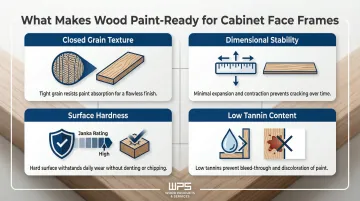
A wood species is considered paint-ready when it possesses four core properties that determine finish quality and longevity:
- Closed grain texture: Diffuse-porous hardwoods like maple, birch, and poplar have small, evenly distributed pores that accept paint smoothly. Open-pored species like oak need grain filler first — otherwise the grain telegraphs through the finish as visible texture.
- Dimensional stability: Wood expands and contracts as humidity changes. Species with a low tangential-to-radial shrinkage ratio (meaning more uniform movement) place less stress on paint films and reduce cracking at stile-and-rail joints over time.
- Surface hardness: The Janka hardness test measures resistance to denting. Harder species hold up better against daily wear — particularly important for lower cabinets in busy kitchens and any commercial installation.
- Low tannin content: Tannins and water-soluble extractives in some heartwoods bleed through paint, leaving reddish-brown stains on light finishes. Species with minimal tannins need fewer primer coats, cutting both time and material cost.
Why Face Frames Have Unique Demands
Face frames differ from other cabinet components because they combine high visibility with structural function. They're touched countless times daily, exposed to kitchen grease and humidity, and must hold perfectly aligned joints despite seasonal wood movement.
A door panel is relatively easy to swap out if the finish fails. Refinishing an entire kitchen's worth of face frames, on the other hand, means removing doors, drawers, and hardware — then working around installed cabinets. Choosing the right wood from the start prevents that scenario entirely.
Best Woods for Painted Cabinet Face Frames
The following species are ranked by their suitability for painted face frames, evaluated on paintability, stability, durability, and cost. For residential and commercial projects alike, these woods deliver professional results when properly prepared and finished.
Poplar
Yellow poplar is the most widely used wood for paint-grade face frames in North American cabinetry. It's a domestic hardwood with a fine, closed grain that accepts paint smoothly with minimal surface preparation. Its straight, uniform grain and medium texture make it easy to machine and join cleanly.
The primary limitation is color variation. Poplar heartwood displays streaks of green, purple, gray, and cream that can bleed through lighter paint colors without a quality stain-blocking primer. While this natural color variation is irrelevant under stain, it requires extra attention for painted applications—typically one or two coats of shellac-based or specialized stain-blocking primer before topcoats.
| Attribute | Details |
|---|---|
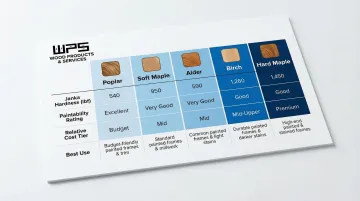
| Paintability | Excellent—smooth, closed grain takes paint evenly; requires stain-blocking primer to prevent color bleed-through on light finishes |
| Hardness/Durability | Moderate hardness (Janka 540 lbf); suitable for most residential face frames but softer than maple or birch |
| Relative Cost | Budget-friendly; typically the most affordable hardwood option for face frames |
Soft Maple
Soft maple (primarily red maple) is a preferred choice among professional cabinet makers for painted face frames. Its uniform, light color and tight grain pattern make it one of the easiest woods to achieve a smooth, professional painted finish with minimal prep work. Unlike poplar, soft maple's more consistent coloring means fewer primer coats are needed, which saves both labor time and material cost in production environments.
At 950 lbf Janka hardness, soft maple is substantially more durable than poplar while remaining easy to machine and finish. Its dimensional stability and fine, even texture make it well-suited for high-traffic residential kitchens where face frames take daily contact and cleaning.
| Attribute | Details |
|---|---|
| Paintability | Excellent—minimal grain telegraphing, uniform surface; one of the easiest woods to achieve a smooth painted finish |
| Hardness/Durability | Good hardness (Janka 950 lbf); more durable than poplar and holds up well to daily cabinet use |
| Relative Cost | Mid-range; slightly more expensive than poplar but often worth the investment for high-traffic kitchens |
Birch
Yellow birch delivers high strength and durability with a straight, fine grain that paints very well. Its Janka hardness of 1,260 lbf makes it harder than pine, alder, soft maple, and poplar — a strong choice where face frames will see heavy use in large households or commercial installations.
Birch has a slight yellowish tone that can deepen with age and UV exposure, a phenomenon known as photoyellowing. For white or very light gray cabinetry, this means using high-quality, UV-resistant paint formulas to minimize underlying color shifts over time. Despite this consideration, birch requires less sealer than many alternatives and offers superior dent resistance.
| Attribute | Details |
|---|---|
| Paintability | Very good—fine grain and light color reduce primer requirements; minor pores may need light sanding between coats |
| Hardness/Durability | High hardness (Janka 1,260 lbf); one of the more durable options for high-use cabinetry |
| Relative Cost | Mid-to-upper range; can cost more than poplar or soft maple, but durability often justifies the price |
Alder
Red alder offers an even grain pattern and fine texture that accepts paint well, making it popular for residential cabinetry where a smooth painted finish is desired at a moderate price point. Its uniform grain distribution and easy machinability mean it machines cleanly with standard tooling and finishes with minimal fuss.
Lower density is the tradeoff. At 590 lbf Janka hardness, alder dents more easily than harder species over time. For painted face frames, this means surface damage may eventually show through the finish in high-traffic areas. Pairing alder with high-quality primer, paint, and topcoat can extend finish life, but it's best reserved for lower-traffic areas or secondary cabinets.
| Attribute | Details |
|---|---|
| Paintability | Good—even grain and texture make it easy to paint; softer surface can show dents through paint over time |
| Hardness/Durability | Lower hardness (Janka 590 lbf); better suited for lower-traffic areas or secondary cabinets |
| Relative Cost | Mid-range; comparable to soft maple in many markets |
Hard Maple
Hard maple (sugar maple) is the most durable wood on this list for painted face frames. Its very low tannin content, light natural color, and tight closed grain mean fewer paint coats are needed to achieve full coverage, and the finish holds up well over decades of use. At 1,450 lbf Janka hardness, it's the top choice for high-traffic kitchens and commercial spaces where face frames take intensive daily use.
Hard maple is heavier and denser than soft maple, which adds structural rigidity to the face frame but also increases both material and machining costs. For projects where longevity is the top priority and budget allows, it's the most durable option available in this category.
| Attribute | Details |
|---|---|
| Paintability | Excellent—light color, tight grain, and low tannin content result in superior paint adhesion and coverage |
| Hardness/Durability | Very high hardness (Janka 1,450 lbf); the most durable option, ideal for high-traffic kitchens and commercial spaces |
| Relative Cost | Higher cost; best suited for premium projects where longevity is the top priority |
How to Choose the Right Wood for Your Project
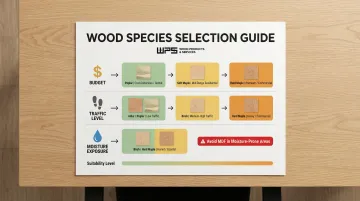
Selecting the right wood species for painted cabinet face frames requires balancing four key factors: budget, traffic level, moisture exposure, and working environment.
Budget vs. Longevity Trade-Off
Poplar is the practical choice for cost-conscious builds. Its affordability and excellent paintability make it ideal for rental properties, spec homes, or projects where upfront cost is the primary concern. With proper primer and quality paint, poplar face frames can deliver 10-15 years of service in typical residential use.
Soft maple and birch hit the middle tier well, offering superior durability and easier finishing (fewer primer coats) compared to poplar. The modest upfront premium often pays for itself through reduced labor during finishing and longer service life before refinishing is needed.
Hard maple is the premium long-term investment. While material costs are higher, the exceptional durability means face frames can last 30+ years without refinishing in residential applications. For commercial installations or high-end custom homes, the extended service life justifies the initial expense.
Traffic Level and Use Environment
Face frames in high-traffic kitchens—especially those with children or heavy daily use—benefit from harder woods like birch or hard maple. The additional dent resistance prevents surface damage from inevitable impacts over years of use.
Lower-traffic areas like bathroom vanities, office cabinetry, or upper wall cabinets experience far less physical contact. Poplar or alder perform well in these applications, delivering smooth painted finishes at lower cost where superior hardness isn't required.
Moisture and Humidity Exposure
For kitchens and bathrooms, prioritize dimensionally stable woods that resist swelling and shrinking as humidity fluctuates. Soft maple, hard maple, and birch offer superior stability compared to less expensive alternatives. Movement in the face frame places stress on paint at stile-and-rail joints, causing hairline cracks that widen over time.
Yellow birch's low T/R ratio (1.3) makes it particularly well-suited for humid environments like coastal homes or poorly ventilated bathrooms. While MDF is sometimes used for painted cabinet components due to its perfectly smooth surface, it should be avoided for face frames in high-humidity areas—moisture exposure causes irreversible edge swelling and structural deterioration.
Working with a Custom Cabinet Maker
Selecting the right wood also depends on joinery method, finish system, and installation environment. Quality Made Cabinets has been building hardwood face frame cabinetry since 2010 and can recommend the right species based on your space, usage patterns, and finish goals.
Contact them at (484) 719-8209 for a consultation tailored to your project.
Getting the Best Paint Finish on Your Face Frames
Even the best wood species won't deliver a professional painted finish without proper surface preparation and paint application. Follow these steps for results that last.
Surface Prep is Non-Negotiable
Lightly sand face frames with 150- to 220-grit sandpaper before priming, working with the grain to avoid cross-grain scratches. Wipe off all dust with a tack cloth, since any residue will create bumps in the primer coat.
Apply a high-quality stain-blocking primer to seal the wood and prevent tannins or color variations (especially critical for poplar) from bleeding through topcoats. For severe bleed-through risk, use shellac-based or solvent-based stain-blocking primers.
Paint Selection Matters
Standard wall paints lack the hardness and washability required for cabinet face frames. Instead, use cabinet-specific formulas designed to withstand daily contact, grease, and moisture:
- Waterborne alkyds like Benjamin Moore ADVANCE combine the flow and leveling of traditional oil-based enamels with water cleanup and low odor
- Acrylic-urethane hybrids like Sherwin-Williams Emerald Urethane Trim Enamel deliver exceptional durability and scratch resistance
- Sheen level: Specify satin or semi-gloss finishes for cabinetry — these sheens are more washable and moisture-resistant than flat or eggshell
Allow Proper Dry and Cure Time Between Coats
Rushing the painting process is the most common reason painted face frames fail early. Understand the difference between dry time and cure time:
- Dry time refers to surface dryness — typically 4-6 hours for cabinet paints, when the paint feels firm but hasn't hardened
- Cure time is when the paint reaches full hardness and durability — typically 5-7 days for waterborne alkyds
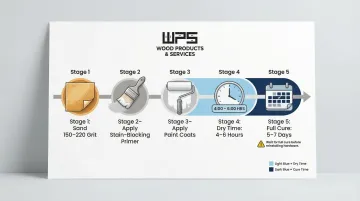
Wait the full cure period before reinstalling doors and hardware or returning cabinets to heavy service. A simple test: press a fingernail lightly against an inconspicuous spot — if it leaves a mark, the paint needs more time.
Conclusion
For most painted cabinet face frame projects, poplar and soft maple offer the best balance of paintability, stability, and cost—delivering smooth, professional finishes at reasonable price points. For premium or high-traffic applications where superior durability justifies higher material cost, birch and hard maple deliver exceptional performance that can last 30+ years.
The right wood choice, combined with proper surface preparation and quality paint products, is what separates a face frame finish that lasts 5 years from one that lasts 30. Getting there requires more than good materials. It takes species selection matched to your specific environment, joinery built to handle real-world stress, and a multi-coat finishing system that cures fully before installation begins.
Quality Made Cabinets has been crafting custom hardwood cabinetry since 2010, serving 780+ residential and commercial clients with a seamless process from material selection through installation. Whether you're planning a kitchen renovation or a commercial installation, their team can guide you through material selection, finish sampling, and custom cabinet design tailored to your space. Reach out at (484) 719-8209 or kitchentransformations@yahoo.com for a consultation.
Frequently Asked Questions
What wood is best for painted cabinet face frames?
Poplar is the top budget choice — affordable, easy to machine, and paintable with a stain-blocking primer. Soft maple is the premium option, with tighter grain and more uniform color that accepts paint smoothly with fewer prep coats and better long-term durability. For stained frames, oak, cherry, or hickory are preferred instead.
Is poplar good for cabinet face frames?
Yes, poplar is an excellent choice for painted face frames. It's a domestic hardwood that is affordable, machines well, and takes paint smoothly. A stain-blocking primer is recommended to prevent its natural color variations (green, purple, and cream streaks) from bleeding through lighter paint colors.
How thick should cabinet face frames be?
Standard face frame stock is 3/4 inch thick, with stiles and rails cut to 1-1/2 to 2 inches wide. That width covers plywood box edges and creates the right overhang for mounting doors and drawers.
What is the front face of a cabinet called?
The front face of a cabinet is called the face frame—the hardwood border attached to the front of the cabinet box (carcass). It consists of vertical pieces called stiles and horizontal pieces called rails, which provide structure, a finished appearance, and attachment points for doors and drawers.