This happens every day, and it's why so many homeowners end up regretting their cabinet purchase within five years. The material you choose affects durability, moisture resistance, maintenance demands, and whether your finish will crack, peel, or hold up beautifully. Making the wrong choice can mean premature wear, costly replacements, or a look that deteriorates faster than you imagined.
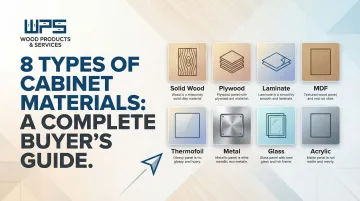
This guide walks through 8 common cabinet materials, what each one is built for, and how to match the right material to your kitchen or bathroom—so you can make a confident decision instead of guessing at the showroom.
TL;DR
- Cabinet materials divide into two categories: natural wood (solid wood, plywood, veneer) and engineered options (MDF, particleboard, laminate, thermofoil, melamine)
- Moisture resistance is the most critical factor—especially for kitchens and bathrooms
- Budget, desired finish (paint vs. stain), and how long you plan to stay in the home should guide your decision
- Each material has distinct trade-offs in durability, cost, and ideal application
- This guide breaks down all 8 options so you can match the right material to your project
What Are Cabinet Materials and Why Do They Matter?
Cabinet material refers to the structural substance used to build the cabinet box, doors, and drawer fronts. Not all cabinets are built the same way—different parts (box vs. door) may use different materials, which is a common cost-cutting tactic in builder-grade cabinets.
Why material matters: two cabinets can look identical in the showroom but deliver very different lifespans. Custom plywood cabinets last 20–30 years compared to just 5–10 years for builder-grade particleboard. That means the "cheaper" option often costs more per year of use.
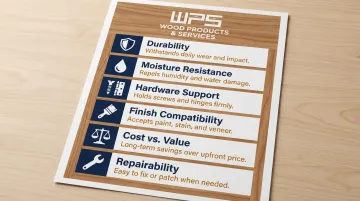
Before choosing a material, weigh it against these six factors:
- Holds up under daily use without warping, denting, or delaminating
- Resists moisture — especially critical in kitchens and bathrooms
- Supports hinge and hardware performance without sagging over time
- Accepts paint or stain well for your preferred finish
- Balances upfront cost against long-term value
- Can be refinished or repaired rather than fully replaced
8 Types of Cabinet Materials
No material is universally "the best." Each performs differently based on environment, budget, and design goals. The following breakdown helps you identify which is best for your specific situation.
Solid Wood (Hardwood)
Solid wood cabinets are made from single, unbroken pieces of natural wood—commonly oak, maple, cherry, or hickory. This is the only material that can be fully refinished multiple times, making it the longest-lasting option for homeowners planning to stay long-term.
Quality Made Cabinets works with sustainably sourced premium hardwoods and applies durable 2K protective coatings. When choosing a custom cabinet maker, ask about sustainable sourcing practices and finish quality — both directly affect how long your cabinets will last.
Key trade-offs:
- Costs 15–50% more than engineered alternatives
- Expands and contracts with humidity; improper sealing causes gaps or splits in steam-heavy kitchens
- Requires regular conditioning and polishing to maintain appearance
Best for: homeowners investing in forever homes who want natural grain, plan to refinish over time, and can maintain proper humidity control.
Plywood
Plywood consists of thin wood veneer layers glued together under heat and pressure, creating a stable, strong panel. Its cross-laminated structure resists warping better than solid wood and holds screws securely, making it a go-to material for cabinet boxes and shelving in quality builds.
Trade-offs:
- Pricier than particleboard or MDF
- Must be sealed properly to prevent water damage at exposed edges
- Veneer surface can peel over time if quality is poor
Best for: cabinet boxes in kitchens and bathrooms, especially in sink base cabinets and high-moisture zones where durability is non-negotiable.
Wood Veneer
Wood veneer is a thin slice of real hardwood (typically 1/45" to 1/38" thick) bonded to a less expensive substrate like plywood or MDF. It offers the visual warmth and grain of natural wood at a fraction of solid wood's cost—popular for cabinet doors in mid-range remodels.
Limitations:
- Can only be sanded and refinished 1–2 times before wearing through
- Brittle at edges—chips or delamination occur with heavy moisture or impact
- Requires balanced construction and rigid glue lines to prevent warping
Best for: homeowners who want the look of real wood on doors and drawer fronts without the cost of solid hardwood, in moderate-use kitchens.
MDF (Medium Density Fiberboard)
MDF is an engineered panel made by compressing wood fibers with resin under heat, creating a dense, uniform, grain-free surface. Its smooth consistency makes it the ideal material for painted cabinet doors—there's no wood grain showing through, and painted finishes come out flawless.
Critical weakness:
- Moisture vulnerability: MDF swells when exposed to water—poorly suited for kitchens with heavy steam or areas near sinks without careful sealing
- Heavier than plywood, which can strain hinges over time
- Cannot be refinished if paint is stripped
Best for: painted cabinet doors in low-moisture environments, modern kitchens with controlled humidity, and homeowners prioritizing a smooth, factory-like finish.
Particleboard
Particleboard is the most affordable cabinet material, made from compressed wood chips and sawdust bonded with resin. Flat-pack and builder-grade cabinets rely on it heavily. Particleboard's edge screw withdrawal is 20% weaker than face withdrawal, meaning it doesn't hold screws as reliably as plywood or MDF.
Key limitations:
- Highly vulnerable to moisture swelling and structural breakdown when wet
- Shorter functional lifespan (5–10 years vs. 20–30 for plywood)
- Better suited for light-duty storage in low-humidity spaces
Best for: budget-constrained projects, rental properties, closets, or laundry rooms where moisture exposure is minimal.
Laminate
Laminate is a synthetic surface made from layers of paper and plastic resin fused under high pressure onto a core (usually MDF or particleboard). High-Pressure Laminate (HPL) is pressed at over 300 psi for superior impact resistance, while Low-Pressure Laminate (LPL, also called TFL or melamine) is more budget-friendly.
Trade-offs:
- Edges can peel or chip over time
- Cannot be refinished—replacement is the only fix once damaged
- Some lower-quality laminates emit VOCs; verify CARB Phase 2 compliance
- Core material underneath remains vulnerable to water at seams
Best for: budget-conscious homeowners wanting scratch and moisture resistance on surfaces, commercial projects, and modern kitchens with slab-style doors.
Thermofoil
Thermofoil is a vinyl film heated and vacuum-pressed onto an MDF core, creating a seamless, smooth surface with no visible grain. It's a popular choice for modern and contemporary kitchens because of its clean, handleless aesthetic and lower cost compared to painted wood.
Major limitation: Thermofoil is highly sensitive to heat—sustained exposure near ovens, dishwashers, or coffee makers causes the film to peel or bubble away from the MDF core. Once peeling starts, it cannot be repaired; the door must be replaced.
Best for: modern kitchens with minimal heat exposure, homeowners on a budget wanting a painted look, and spaces where cabinet doors are far from heat-generating appliances.
Melamine
Melamine works like a thinner version of laminate: resin-treated paper bonded to a particleboard or MDF core under heat. Budget-friendly and IKEA-style cabinets use it often. It offers more moisture resistance than bare particleboard and comes in a wide range of colors.
Trade-offs:
- Edges prone to chipping and peeling, especially along corners
- If coating chips and core gets wet, swelling and degradation occur
- Cannot be refinished once damaged
Best for: budget builds, rental properties, cabinet interiors, pantry storage, and spaces where aesthetics matter less than function.
How to Choose the Right Cabinet Material
The "best" cabinet material depends on your specific situation—budget, kitchen environment, aesthetic goals, and long-term plans—not on what looks good in a showroom.
Start with the Moisture Factor
Moisture resistance is the most important first filter. Kitchens with heavy steam, proximity to sinks, or humid climates should prioritize:
- Plywood boxes with sealed edges
- Laminate or thermofoil surfaces (away from heat)
- Avoid unprotected MDF or particleboard cores near water sources
Bathroom vanities and laundry rooms demand moisture-resistant cores. Quality Made Cabinets designs bathroom cabinets with moisture-resistant materials and protective coatings tailored for high-humidity environments.
Paint vs. Stain: Material Dictates Finish
Your finish choice narrows material options immediately:
- Painted finish: MDF or thermofoil deliver the smoothest results
- Stained or natural wood finish: Only solid wood or wood veneer can achieve authentic grain—engineered boards cannot be stained to show wood grain
Budget Tiers and Long-Term Value
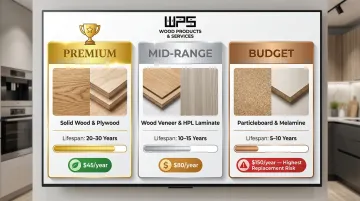
Premium investment (longest lifespan):
- Solid wood and quality plywood
- 20–30 year lifespan
- Highest upfront cost, lowest cost-per-year
Mid-range value:
- Wood veneer and HPL laminate
- 10–15 year lifespan
- Good aesthetics, moderate durability
Budget/short-term:
- Particleboard and melamine
- 5–10 year lifespan
- Lowest upfront cost, higher replacement risk
Those budget tiers assume standard configurations. Custom cabinet work changes that math. Quality Made Cabinets lets you specify box and door materials independently—plywood boxes for moisture resistance paired with painted MDF doors for a smooth finish—so the cabinet is built around your kitchen, not around a manufacturer's standard configuration.
Common Mistakes to Avoid When Choosing Cabinet Materials
Most material missteps come down to three things: trusting appearances, missing what's inside the box, and underestimating what cheap costs over time. Here's what to watch for:
Judging by looks alone. Thermofoil and MDF can look identical to painted wood in a showroom. That similarity disappears fast in a steam-heavy kitchen—surface finish tells you nothing about moisture resistance or heat tolerance.
Overlooking what's inside the box. Budget cabinets often pair a solid wood door with a particleboard box—a standard cost-cutting move in builder-grade lines. Always ask specifically: "What material is the box, and what material are the doors?"
Ignoring the long-term math. Particleboard and low-grade melamine cost less upfront but often need replacement within 5–10 years. According to a cost breakdown from MyKitchenCrest, an $8,000 plywood kitchen lasting 20 years runs $400/year—while a $5,000 particleboard kitchen lasting 7 years costs $714/year. Plywood boxes and quality doors typically win over a 20-year horizon.
Conclusion
Cabinet material is one of the most consequential decisions in any kitchen or bathroom renovation—it shapes the look, lifespan, and upkeep demands of the finished space for years to come.
Understanding the differences between the 8 types—from solid wood's proven durability to laminate's budget-friendly practicality—puts you in a stronger position to choose intentionally, not reactively. Match material to your moisture exposure, budget, and long-term plans, and your cabinets will deliver value for decades.
If you're still weighing options or want a material recommendation tailored to your specific space, Quality Made Cabinets has been helping Pennsylvania homeowners and commercial clients make that call since 2010—with custom-built results to show for it.
Frequently Asked Questions
What are the different types of cabinet materials?
The 8 main types are solid wood, plywood, wood veneer, MDF, particleboard, laminate, thermofoil, and melamine. Each has a distinct performance profile suited to different budgets, moisture environments, and finish preferences.
What is the best material for kitchen cabinets?
Solid wood and plywood lead for durability and longevity (20–30 years), while laminate and MDF are strong budget choices for painted finishes. The right pick comes down to moisture exposure, budget, and whether you want a stained or painted look.
Should I use 1/2 or 3/4 plywood for cabinets?
3/4-inch plywood is the standard recommendation for cabinet boxes, providing superior screw-holding strength and structural rigidity. 1/2-inch plywood is sometimes used for cabinet backs or interior shelving where load-bearing demands are lower.
What are most builder grade cabinets made of?
Builder-grade cabinets typically use particleboard or low-grade MDF for the box, with melamine or thermofoil surfaces on doors. They are cost-effective but generally have shorter lifespans (5–10 years) and less structural integrity than custom or semi-custom options.
What is the best finish for kitchen cabinets?
Painted finishes work best on MDF or thermofoil for a smooth, modern look, while stain or clear-coat finishes require solid wood or wood veneer to showcase natural grain. The best finish depends on both the material chosen and your desired aesthetic.
How do you tell if cabinets are MDF or particle board?
MDF has a dense, smooth, uniform surface with no visible particles. Particleboard is lighter with a rougher texture and visible wood chips. Check an unfinished edge — inside the cabinet box or at any cut section — to identify the core material.